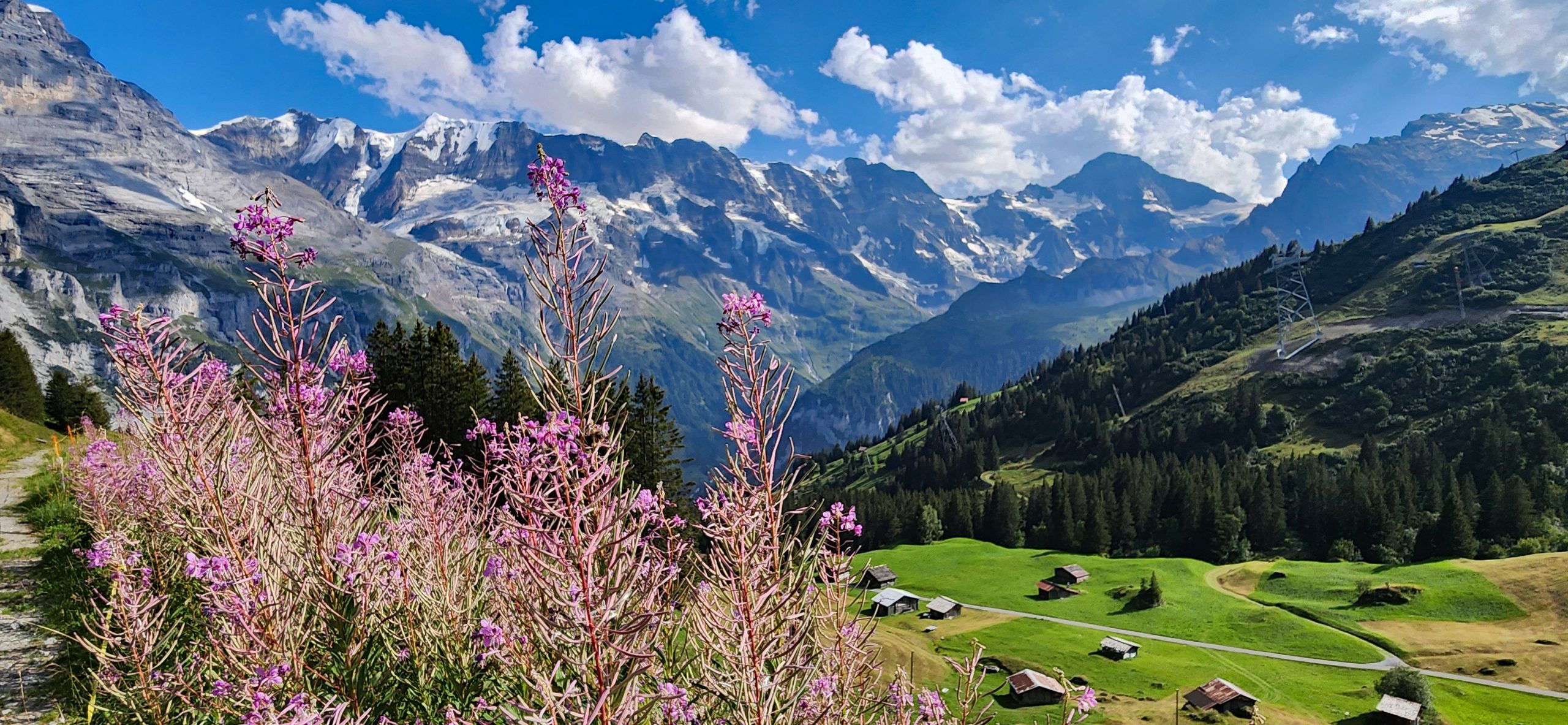
In August 2024, my wife Janis and I celebrated our 40th anniversary with a 12-day hiking trip to the Swiss Alps (dipping our feet briefly into France as well). Each day brought new wonders, new adventures, and new reflections. I hope you enjoy my ramblings.
Saturday – August 24, 2024
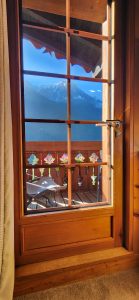 If pulling away from Lucerne and Lausanne was difficult, departing Chamonix on Saturday morning was as painful as a divorce.
We woke early and squeezed every last minute we could out of our hotel balcony at the Auberge Du Bois Prin (‘house of the little wood’). The glorious sunrise and Mont Blanc’s morning glow was a copy-and-paste of the day before, as was my transfixed euphoria from being immersed in it.
I have these transcendent moments when I travel of desiring to stay in a place forever and never return to my old, dull life. But I wonder: How long till the new place becomes the old place? How long till the Chamonix sunrise becomes dull? A lesson life has long tried to teach me is to take responsibility for my contentment, and not leave it on the external thing. There’s more beauty waiting undiscovered in your backyard than you know what to do with. Go find it. Or find the beauty in your marriage. Or your church. Or your work.
Even so, it’s nice to have moments where you don’t have to work so hard at it, like the one I was enjoying on the balcony. But a new Beauty awaited back north, nestled in the Berner Oberland region – the secluded mountain village of Mürren. So with a deep sigh of sorrow and gratitude, Janis and I abandoned the balcony to its next suitors.
The Berner Oberland
As when we left Lausanne a couple days earlier, the train ride from Chamonix was every bit part of the experience. It was a 3-hour pleasure-cruise through picturesque villages like Martigny, Visp, and Spiez, winding through the caress of mountain passes, ear-popping tunnels, and past lakes so blue you could gaze into them for hours. (The sundry rides we took from Lausanne to Chamonix, now back north to Mürren, would tally just shy of $400 if purchased separately, bringing our Swiss Travel Pass investment down to $751 till break-even.)
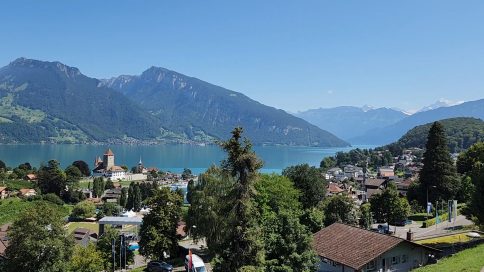
The train delivered us in three hours to Interlaken, the doorway into the Berner Oberland (Oberland meaning the “Uplands” of the central canton of Bern). But calling these mountains uplands is like calling mountain lions cats. For these are the mountains most people imagine when they first hear the word Switzerland.
The hills-alive-with-the-sound-of-music are here. The Delectable Mountains that Christian beheld approaching the Celestial City are here. James Bond loved – and lost – here. An ogre haunts the dreams of a young maiden here. A valley fed by 72 waterfalls – which inspired Tolkien’s Rivendell – is here. Everything about this place is enchanted.
Interlaken – “between the lakes” – made a compelling case for us to linger around its two dazzling finger lakes of Thun and Brienz, or hike to Harder Kulm for a first glimpse at the famous peaks of Eiger, Mönch, and Jungrau. But if you have tickets to the Magic Kingdom in your hands, why would you hang out in the parking lot? Just get inside.
Thanks Interlaken, but we jumped on the R-62 for a 22-minute train ride to Lauterbrunnen, Tolkien’s doorway into Middle Earth. Knowing we’d be back, we snatched a reverent gaze at its cliffs and misty waterfalls as we crossed the road for the cable car ride that would hoist us up in 5-minutes to Grütschalp, and from there transferred to a train that carried us in 11-minutes (with one quick stop in Winteregg…I know, right? Winteregg!) to Mürren.
This little 11-minute ride though was electrifying. First, we climbed above the hills of the Lauterbrunnen Valley, which were dressed with alternating ribbons of light green meadows and dark green forest. Then the granite-white cliffs appeared, some as high as 3,000 feet, sheer and vertical as a Greek temple. But then suddenly, slowly lifting up from behind the cliffs (to the sound of heavenly trumpets and trombones for those with ears to hear it), arose the purple mountains majesty of Eiger (the ogre who stalks the young maiden, at 13,015 ft.), Mönch (the monk who protects the young maiden, at 13,448 ft.), and Jungrau (the virginal young maiden herself, at 13,642 ft.).
Imagine being on a kayak on the ocean, admiring otters playing in the harbor, when suddenly the ocean surface ripples behind them, and a pod of massive whales pierces through the water. That was the sensation here. The only difference being we would now be allowed to gawk, touch, laugh, and play with these rocky whales for the remainder of the day. And the next. And the next.
Mürren the Majestic
So we arrived in the mountain hamlet of Mürren. Whatever you imagine a “hamlet” to be (or not to be), with less than 4 square miles, and 400 yearly residents, Mürren is one. And a carless one at that. No vehicles allowed. No traffic reports on the 8’s. No horns, unless attached to a cow.
At 5,374 feet, it’s a paradise perched near the edge of a cliff overlooking the Lauterbrunnen Valley, while being overlooked by the Big Three mountains, with all their children and grandchildren.
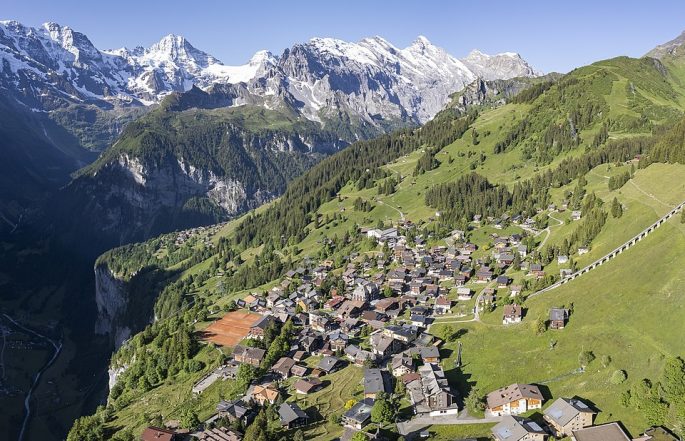
By Pahcal123 – Own work, CC BY-SA 4.0, https://commons.wikimedia.org
However, though small, there are at least 2,000 hotel rooms in Mürren, and ours was at the other end of the village, at the Hotel Alpenruh. Only this walk was a mere third of a mile and completely level, along the village’s main road that was lined with quaint shops, dressed chalet-style, with flower-decked balconies, though none higher than two-stories lest the view of the ring of Alps encircling us be blocked. If I had to walk that path with ten Alpa luggage-packs strapped to me (loaded with boulders), I would have counted it a privilege.
All this under a pure blue sky washing us in summer warmth and sunshine. And we still had nearly six hours of daylight left to play in. “Better is one day in your courts than a thousand elsewhere,” declared the psalmist, and I now had a sense of why he felt that way.
Though I’m a nap connoisseur, that would have been a blasphemy on this afternoon. We checked in swiftly, stuffed some water and snacks in our hiking packs, and were back out the door before you could say Swiss Family Robinson.
Mürren is the gateway to dozens of classic hikes, the truth of which is that there’s not a bad choice you can make. Any direction you head in will lead to delight. Not to mention, it’s all but impossible to get lost because every path is thoroughly but tastefully marked. However in the end, you still have to make a choice. (Which is anathema to my dear wife, who throughout her vacationing life has a tendency to pine for all the paths she’s missing out on and bemoan the one she’s on. She does that with desserts and TV programs also. But thankfully not husbands.)
For this afternoon on this day, we chose the classic Northface Trail hike, a 5+ mile loop hike above Mürren, with loads of scenic options and cul-de-sacs to explore, places to find an ale or sandwich, or a waterfall, and view after view that will make you belt out singing uncontrollably like Julie Andrews.
The Northface Trail – A Hiking Wonder
We chose to take the counterclockwise route which was accessed by taking a funicular straight up the mountain behind the town, only because we didn’t want to run the risk of finding it closed if we went the other way, then having to walk down a steep hillside in the dark. (Knock another $28 dollars off our Swiss Travel Pass balance – $723 to go.) In hindsight, I’d do it this way every time, because you’re almost always walking with the mountains in front of you, whereas doing it clockwise would have you looking back over your shoulders for large portions of it.
The funicular is short, and fun of course. It’s not called a shorticular. It deposits you at the Allmendhubel, a “paradise for families and children” says its website. I would have to agree. It had an amazing playground with Honey-I-Shrunk-The-Kids-size insects, flowers, swings, and forts for the kids, a flower trail for the adults which claims to display up to 150 varieties of Alpine flowers (though in late August as we found out, that number drops to about 3 or 4), a restaurant, and other treasures.
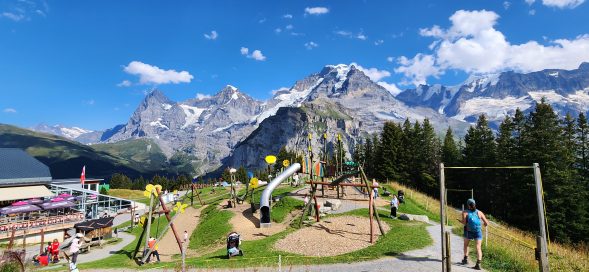
Unlike many of my favorite White Mountain hikes in New Hampshire which take their sweet time before they yield any vistas and views, the Northface Trail is generous with its beauty from start to finish. Leaving the Allmendhubel, we softly descended a scant fifth of a mile through a tiny stretch of woods, before the trail entered a vast circular clearing, which curved around a vintage Swiss tableland of small farms and cottages, while birdsong and distant cowbells echoed across the valley. Along with a faint pounding drum that sounded out of place.
We took just a few steps out of the woods into the clearing and beheld…a doorway into heaven. Another psalm came to life in front of us. “As the mountains surround Jerusalem, so the Lord surrounds his people.” To our left stretched a wall of Alps (sounds too foreboding), a bowl of Alps (sounds like cereal; “Pass me the Alps, please”), a hug of Alps (there, that’s better), inviting us into its embrace.
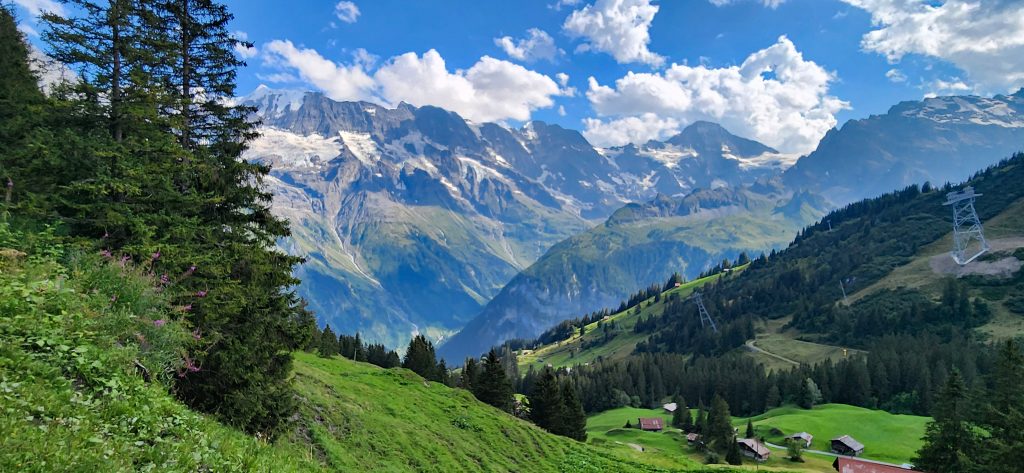
One of the three or four remaining wildflowers left in Switzerland – a lovely purple-pink one – ornamented the path (Rosebay Willowherb says my inner botanist, though I’m an English major, so I might have it wrong; or is it wrongly? I forget. But I also have an M-Div and can quote lots of psalms.)
The Northface dropped down into the valley and swung wide around the farms, though there were multiple roads-less-traveled that we might have taken to explore, tormenting my lady. But it was early in the hike and we had miles to go before we slept, so I kept on walking the sodden pasture lane, and said to Janis, “You come too.”
But my goodness. If you could drink Beauty in, this was as close to visual intoxication as I had ever come. Every step you had reason to stop. It’s the nature of hiking. Move just a little bit, climb just a little higher, turn this way or that, and the view shifts just enough to become something you’ve never seen before.
There’s a way to consummate romantic love, but how do you satisfy the desires that nature stirs within you? Robert Frost drew oh so close to it in his many verses about nature. (By the way, I referenced four of his poems two paragraphs up. Kudos to you if you caught them.)
It Wasn’t All Sunshine And Rosebay Willowherbs
As we wended our way around the valley toward a rise on the other side, the faint drumbeat we heard earlier grew louder until we found its source. In a clearing, we found several canopies and tents set up, loud music blaring, with a dozen or so young people milling about doing what exactly, we couldn’t say.
We narrowed our theories down to two: 1) a music festival of some kind for the rural youth of the Berner Oberland, because teens the world over must sow their wild oats (though it wouldn’t surprise me if these teens literally sowed wild oats); or 2) a cheese-making ritual that involved drums, yodeling, and midnight dancing. You be the judge.
My vote was for the cheese. Because no sooner did we hike past them than we entered a long stretch of the trail set upon by ravenous flying ants obviously drawn by some food source. Here we were a week into our trip, and not one fly had molested us, as if the Swiss had engineered a way to banish bugs from their borders. (I wouldn’t put it past them.) But nope. They just had banished them all to one spot in the middle of their country. Which we were now walking through.
I preferred the fake big ones back at the Allmendhubel. These were small and airborne, with a fetish for ankles and American blood, that forced us to quickstep our way past a unique view looking down on the whole of Mürren where the cliff-plateau it rested on was plainly visible. We snapped some speedy pictures, then fled.
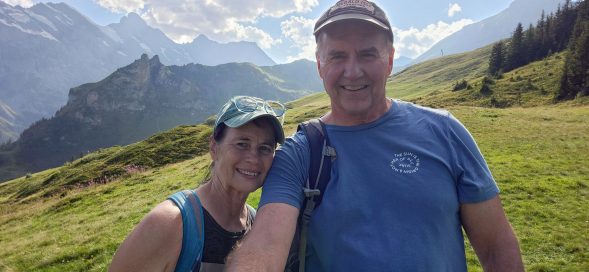
Thankfully though, our torment didn’t last. The ant horde thinned back out as we climbed up a hill, passed through another knob of woods, through a fence, and up into a mountain meadow that was a dead ringer for the one that had Julie Andrews in ecstasy in the opening of The Sound Of Music. Janis felt it too, as you’ll see below.
For the next two hours we had the remainder of the Northface virtually all to ourselves. Not a bug, not a human anywhere in sight. It was the two of us and God, who surely enjoyed us as we enjoyed his handiwork.
When the trail horseshoed back around toward Mürren, we found ourselves walking directly toward the mountains, which seemed to rise up two feet higher for every foot we traveled, especially the Jungfrau. Come to find out, the Young Maiden had an extraordinarily large nose, which perhaps partially explained why the Ogre was attracted to her.
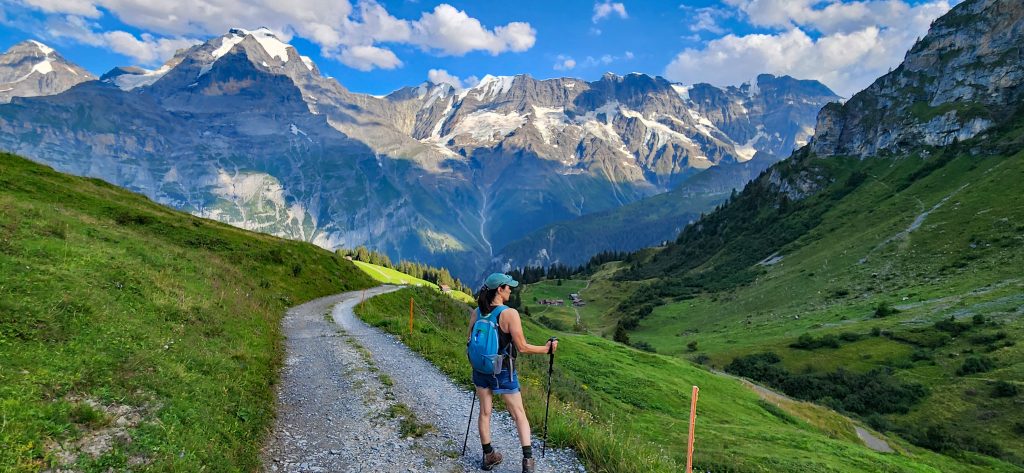
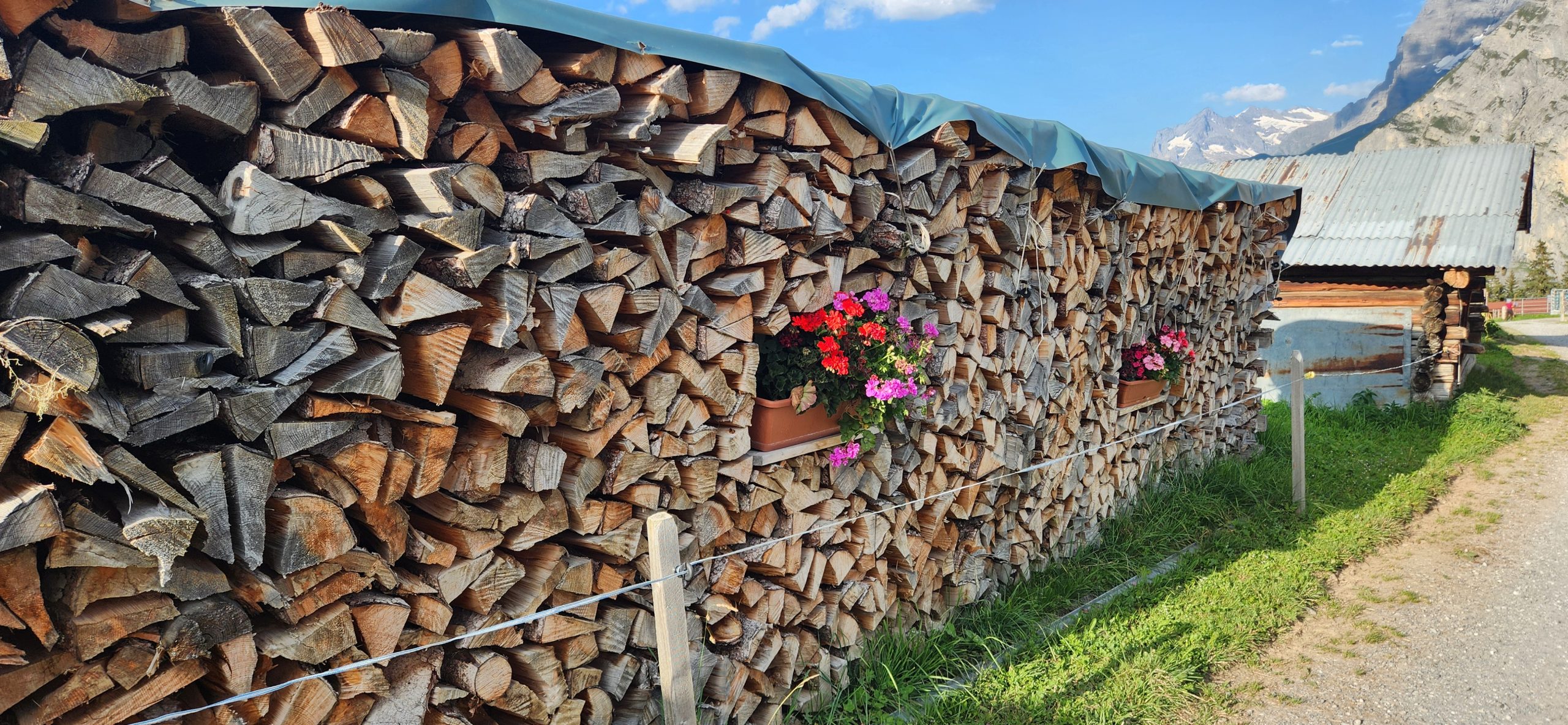
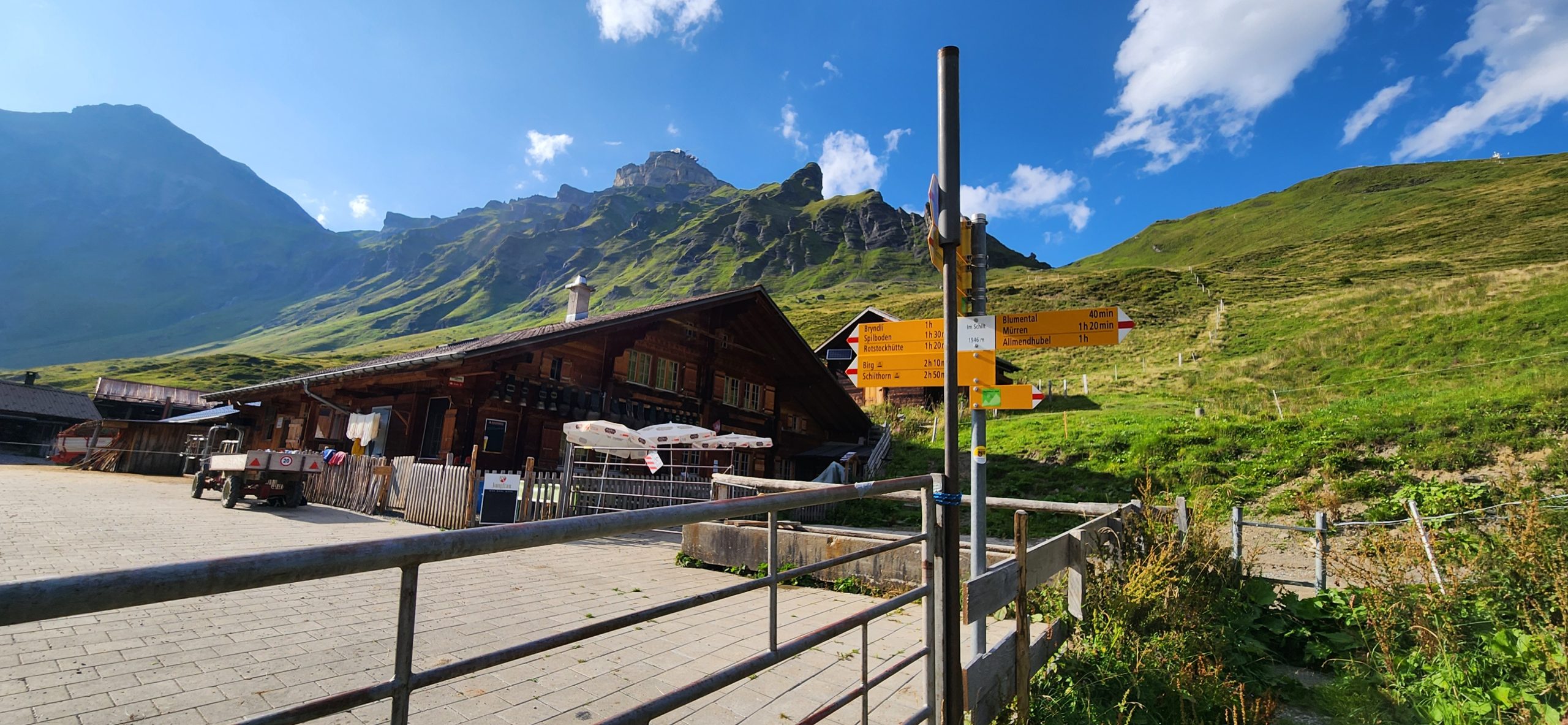
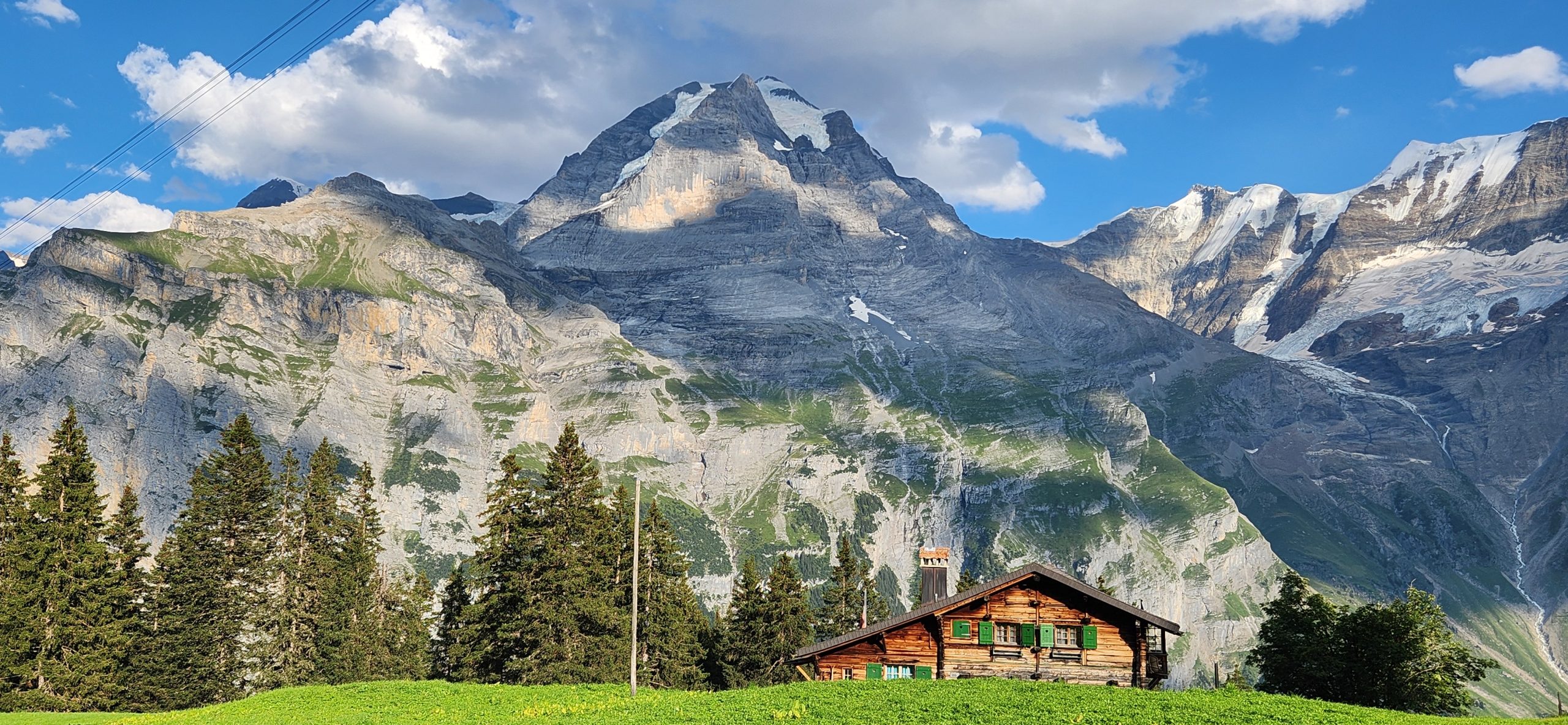
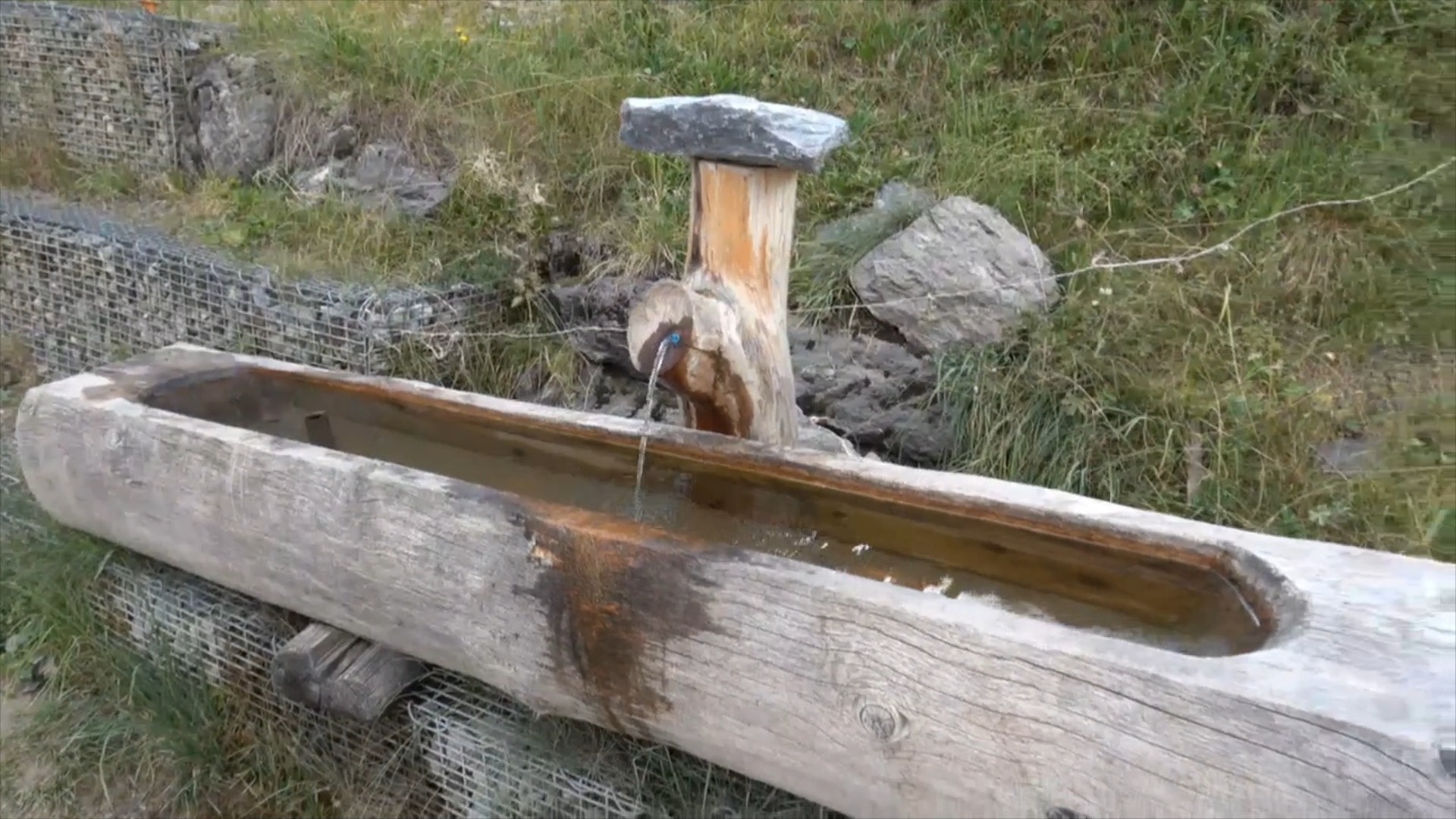
As the sun slowly began its retreat, we were rewarded with a revolving collage of one spectacular panorama after another. We passed more farms and huts ornamented by Currier and Ives stacks of wood plugged with flowers, and clever water troughs for thirsty hikers.
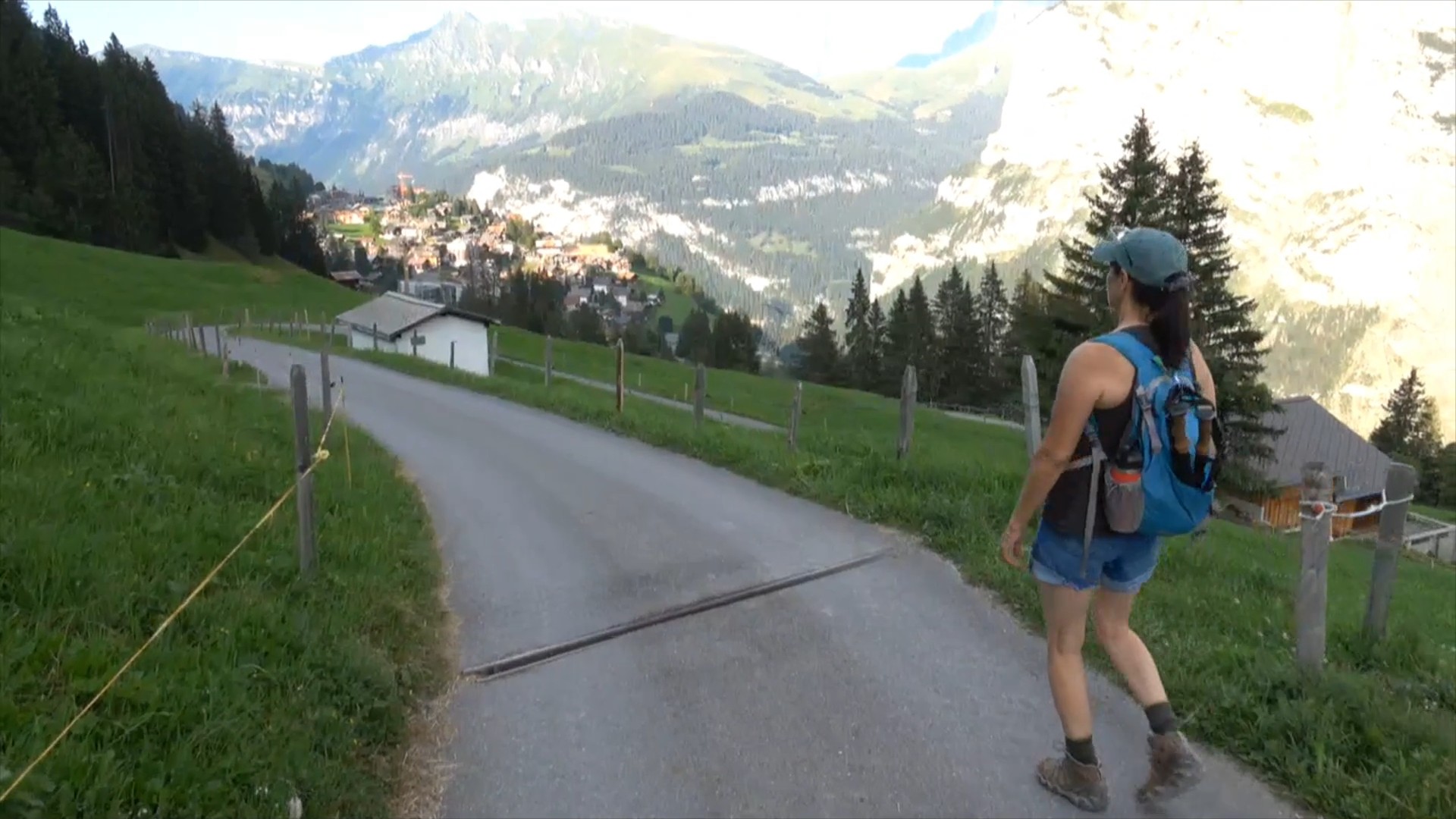
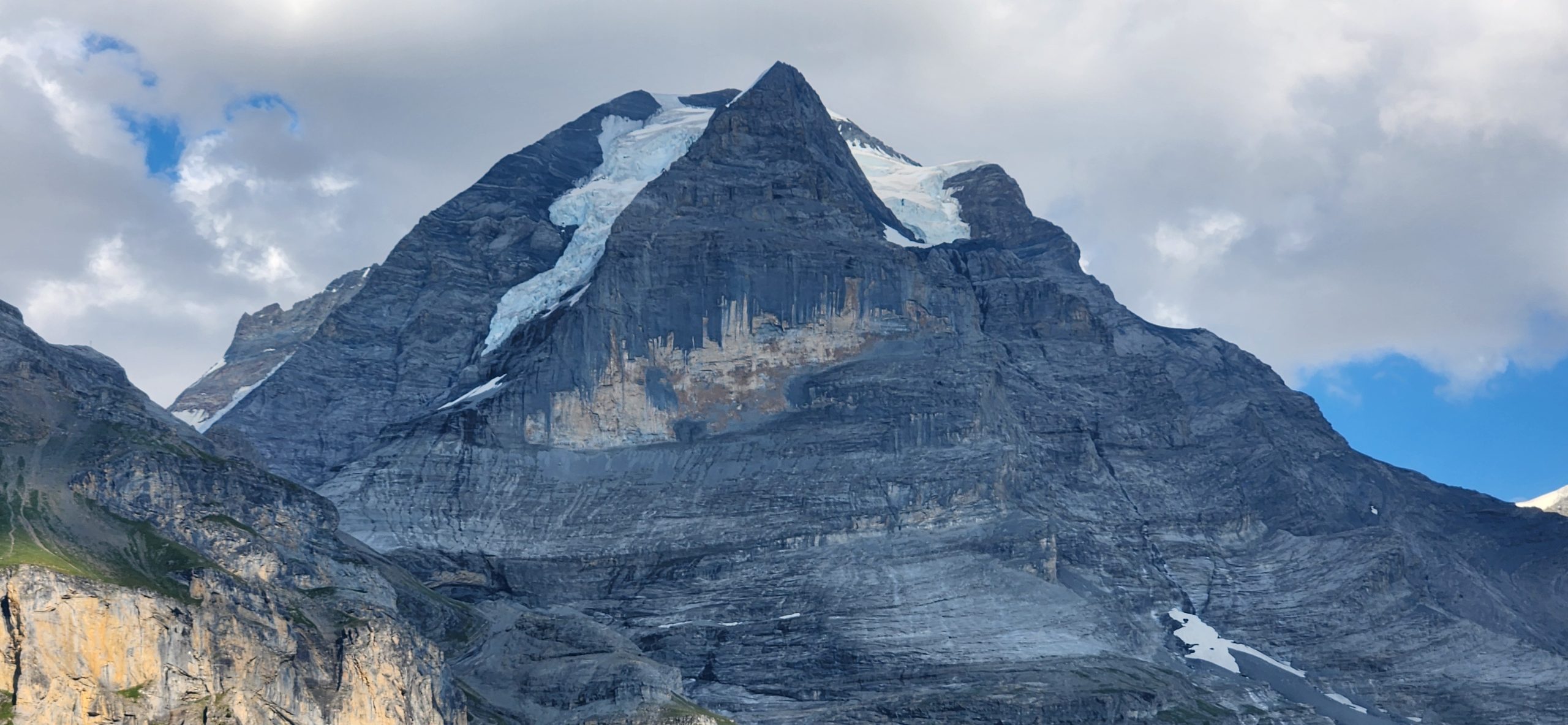
We gaped at distant, silent waterfalls cascading down the folds of the mountains.
And then enjoyed some marriage banter as we descended back down into our hamlet home, for a well-earned, pricey, savory, supper of beef stroganoff. Vacation perfection.
Don’t be jealous though.
That night we cracked open the screenless windows to fill our room with mountain air hoping to sleep like Hansel and Gretel in their home beds. Instead, we filled the room with flies, which ambushed us in our sleep, forcing us awake for a midnight massacre. It took an hour before every buzz was silenced, and we could nod off back to sleep.
The Power Of Beauty
“Beauty” is a common topic for meditation these days in the fields of philosophy and theology. It wasn’t always this way. American-Japanese artist Makota Fujimura remembers when he was first making his way into the New York City art world how the idea that there was even such a thing as Beauty was widely scorned.
“Beauty is in the eye of the beholder” held sway, because to concede that there was anything objective about beauty would call into question the subjective, deconstructed worldview held by most. Once you point to a “standard” with which to gauge the beauty of something, you’ll soon be looking for a “standard bearer”, and sooner or later, you’ll run into God, and we certainly can’t have that.
But then 9-11 happened, and in its aftermath, Fujimura observed a thirst and longing for Beauty re-emerging in the cultural landscape. Suddenly, the classic biblical worldview which inspired Fujimura’s art made sense again.
“Even if we would agree that beauty is not necessary to our daily survival, it is still necessary for our flourishing,” Fujimura writes in his book Culture Care: Reconnecting Beauty For Our Common Life. “Our sense of beauty and our creativity are central to what it means to be made in the image of a creative God…Our soul hungers for beauty.”
Cultural apologists like Paul M. Gould and Roger Scruton point to beauty as a powerful resource to use when defending the goodness and plausibility of Christianity. “Beauty calls us home. It awakens and transports us,” writes Gould. “Beauty – in nature, in art, in humans, in the divine – awakens a longing within us for a world where everything is as it should be…Beauty is a divine megaphone to rouse a disenchanted world.”
“Even if we would agree that beauty is not necessary to our daily survival, it is still necessary for our flourishing.” – Makoto Fujimura
Beauty makes no sense from a natural selection perspective, a realization science is openly wrestling with. (“The extravagant splendor of the animal kingdom can’t be explained by natural selection alone — so how did it come to be?” asked the New York Times.) The fact that food in the Garden of Eden was “good for food” makes sense (Genesis 3:6); but that it was also a “delight to the eyes” baffles the non-theist.
It should also unnerve them. “There is a sort of schizophrenia that occurs if you are listening to Bach, and you hear the glory of God and yet your mind says there is no God and there is no meaning,” observed Tim Keller.
Fujimura however believes in the power of beauty to do even more than awaken faith. Dostoevsky wrote, “Beauty will save the world”. Fujimura in Culture Care explains how.
He describes decades of Christians fighting endless culture wars as a largely failed strategy, that has bred only toxicity and division. Instead Fujimura appeals to artists of faith to be “border stalkers” who will use the beauty of their art to “teach society a language of empathy and reconciliation”.
Much like Harper Lee did in To Kill A Mockingbird and Mahalia Jackson did through her gospel songs and the tortured Vincent van Gogh through his paintings, these border stalkers “…can cast the appealing vision of beauty in the face of injustice, revealing brokenness and need, modeling love for the unlovable, revealing complexities, brokering reconciliation, teaching us to speak appealingly and persuasively, guiding the whole community throughout the challenges of engaging with culture, leading us away from fragmentation and onward toward reintegration, and – perhaps – even uncovering again the Spirit’s light in the churches.”
Bear Clifton, writer and screenwriter, is the pastor of BridgeWay Community Church in California, Maryland. His blogs, screenplays and devotionals can be enjoyed at his ministry website: trainyourselfministry.com and his writing website: blclifton.com. Bear is also the author of “Train Yourself To Be Godly: A 40 Day Journey Toward Sexual Wholeness”, “Ben-Hur: The Odyssey”, “A Sparrow Could Fall”, and his latest – “Living Under The Cross”, a collection of essays on the Beatitudes – all available through Amazon.


Leave A Comment